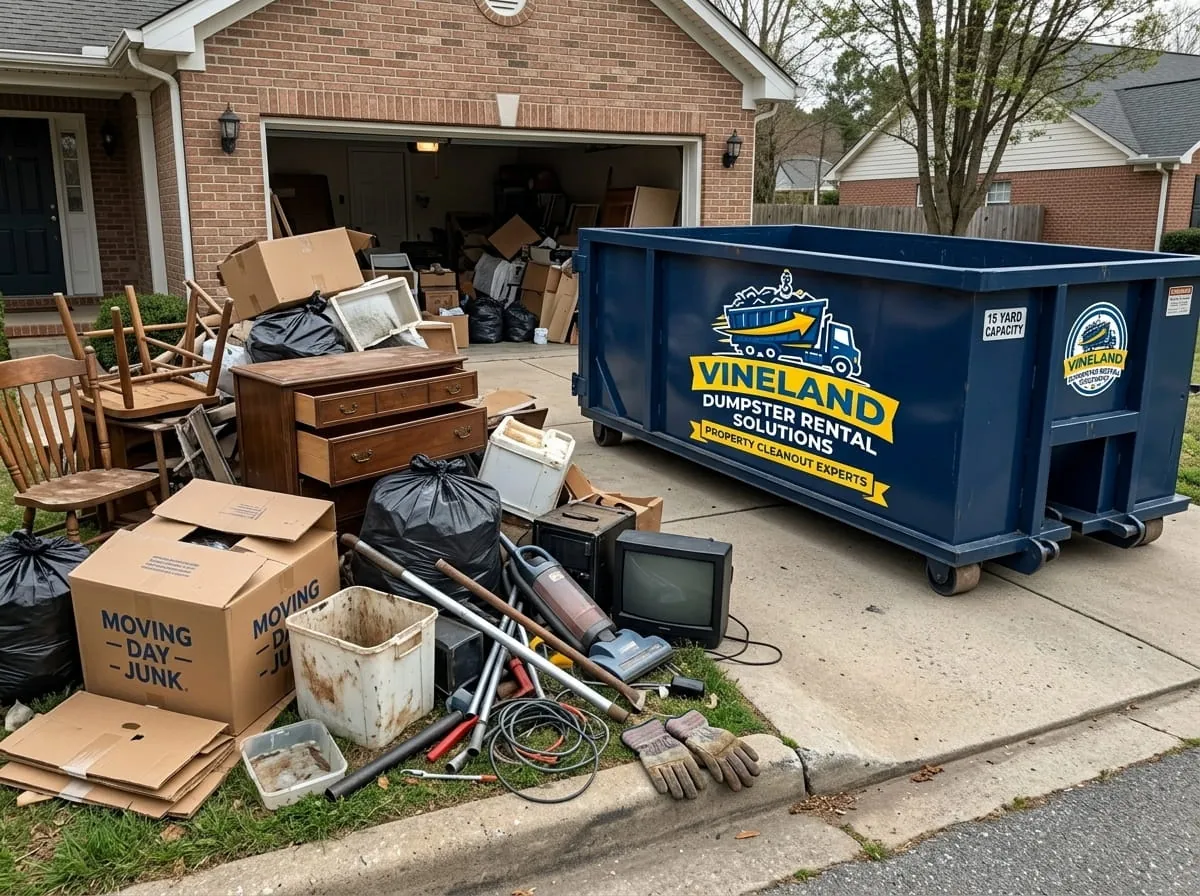
Every week someone calls us and opens with the same line: "I have no idea what size I need." That's fine. Guessing dumpster size is not something most people do more than once or twice in their life, and the price of guessing wrong is real. Order too small and you're either paying for a second haul or cramming debris into a container that's already at the fill line. Order too big and you paid for empty air that sat in your driveway for a week. This guide is meant to fix that, using the projects we actually see around Vineland, Millville, Bridgeton, Vineland's rural edges out toward Newfield, and the rest of Cumberland County.
Roll-off dumpsters are measured in cubic yards. A 10-yard box holds ten cubic yards of material, a 30-yard holds thirty, and so on. But volume is only half the story. The other half is weight, and weight is where South Jersey homeowners get surprised, because the heavy stuff we deal with here (wet soil after a rain, old asphalt shingles, concrete, plaster from those older Landis Avenue homes) fills up your weight allowance long before it fills up the box.
The two numbers that actually matter: volume and weight
Think of it like checking a bag at the airport. There's how much fits, and there's how much it's allowed to weigh. Every roll-off comes with a tonnage allowance included in the base price. Go over that allowance and there's a per-ton overage fee, because the landfill and transfer stations charge us by the scale ticket, not by the container.
Here's the rule of thumb we give people: light and bulky material (furniture, cardboard, insulation, general household junk, bagged trash, deck boards) is a volume problem. You'll run out of space before you run out of weight. Dense material (roofing shingles, dirt, sod, concrete, brick, tile, plaster, wet drywall) is a weight problem. You'll hit the tonnage cap with the box only half full. Mixing the two is where planning matters, and it's worth a two-minute phone call before you book.
10-yard dumpster: the small, heavy-job box
A 10-yard runs roughly 12 to 14 feet long, 8 feet wide, and about 3.5 feet tall. It holds about the equivalent of three or four pickup truck loads. It's short, which is exactly the point, because you can walk right up and toss things in over the low wall without a ramp.
The 10 is our go-to for the heavy, dense jobs where a bigger box would tempt you to overload it. A single-layer roof tear-off on a smaller ranch, a bathroom demo, a concrete patio removal, or hauling out old dirt and sod from a yard project. In our older housing stock around Vineland and Bridgeton, plaster-and-lath demo gets heavy fast, and a 10-yard keeps you honest on weight. If you're pulling up a patio slab or a walkway, this is almost always the right call. You will not fill it to the top with concrete, and you shouldn't try to.
Good fits for a 10-yard
- Single bathroom remodel or demo
- Small roof tear-off (roughly 1,200 to 1,500 sq ft, one layer)
- Concrete, brick, or dirt removal
- Small garage or shed cleanout
- A single room gutted down to the studs
15-yard dumpster: the in-between that solves a lot of problems
Not every company carries a 15, but it's an underrated size. It gives you noticeably more room than a 10 while keeping the low, easy-loading height. Around 16 feet long and about 4 feet tall. When a 10 feels tight but a 20 feels like overkill, the 15 is usually the honest answer, and it often saves you money over sizing up.
We steer a lot of medium cleanouts and light remodels here. A two-room flooring tear-out, a larger garage cleanout with some furniture, a kitchen demo without the cabinets going in the same box. It's also a smart choice for a mixed job that leans a little heavy, like a deck teardown where you've got lumber plus some concrete footings.
20-yard dumpster: the workhorse
If we had to bet on one size for the average Cumberland County homeowner project, it's the 20. Roughly 22 feet long, 8 wide, and about 4.5 feet tall. It's the most rented box we have, and for good reason: it's big enough to handle a real renovation but still short enough to load without breaking your back, and it fits in a standard driveway without eating the whole thing.
The 20 is the sweet spot for a full-house decluttering, a large garage-plus-basement cleanout, a roof tear-off up to two layers on an average home, or a good-sized deck removal. It's also the size we recommend for most flooring and drywall renovation jobs where the material is bulky but not brutally heavy. If you're doing a kitchen remodel with cabinets, countertops, flooring, and drywall all going out, the 20 usually swallows it. You can read more on our 20-yard dumpster page for exact dimensions and weight allowances.
Good fits for a 20-yard
- Whole-home cleanout or major decluttering
- Roof tear-off up to two layers on an average-sized home
- Kitchen remodel with cabinets and flooring
- Large deck or above-ground pool removal
- Carpet and flooring removal across several rooms
30-yard dumpster: for the big, bulky jobs
A 30-yard is where things get serious. About 22 feet long like the 20, but taller, closer to 6 feet. That extra height means real volume, but it also means you're lifting debris higher, so it's built for high-volume, lighter material rather than dense demo waste.
This is the box for a whole-home renovation where multiple rooms are being gutted at once, a large estate cleanout where decades of belongings are coming out of a house all at the same time, new construction debris, or a commercial clear-out. When a family is emptying a parent's home in Vineland and there's furniture, boxes, an attic full of storage, and a basement that hasn't been touched in thirty years, the 30 is the move. Trying to do that job in a 20 means two rentals and two hauls, which costs more than just getting the bigger box once.
One caution with the 30: because it holds so much, it's easy to overload on weight if you start throwing in the wrong material. Never fill a 30-yard with concrete, dirt, or shingles. Those go in a 10. The 30 is for bulk, not tonnage.
Real-world project examples
Garage cleanout
A standard two-car garage packed with the usual (old furniture, boxes, a broken lawnmower, paint cans, bikes) fits comfortably in a 10 or 15. If the garage cleanout is really a whole-property cleanout in disguise, and you know it always creeps, size up to a 20.
Bathroom remodel
A single bathroom gut, tile, tub, vanity, drywall, and all, is a 10-yard job almost every time. The material is heavy (tile and old cast iron especially), so the smaller box keeps you under the weight cap. Two bathrooms at once, go to a 15.
Roof tear-off
Shingles are heavy. A typical asphalt roof runs about 250 to 400 pounds per square (a 10x10 area). For a single-layer tear-off on an average Vineland home, a 10 or 15 usually does it. Two layers or a bigger roofline pushes you to a 20. Never go bigger than you need on a roof job, because a mostly-full 30 of shingles is an overage bill waiting to happen.
Whole-home renovation
Multiple rooms gutted, flooring out, kitchen and baths demolished, that's a 30-yard job, and sometimes it's a 30 that gets swapped for an empty one partway through. If the job is phased, renting a 20 and doing a swap can be cleaner than one giant box.
Estate cleanout
The volume on these is deceptive. A full house of furniture, clothing, kitchenware, and stored belongings takes up far more room than people expect because almost none of it is dense. A 30-yard is standard. For a smaller home or apartment, a 20 will do. These are the jobs where our residential dumpster rental service gets the most use.
Not sure which way to go? Tell us what the job is and we'll size it honestly, even if that means talking you into a smaller box. Call Vineland Dumpster Rental Solutions at (856) 636-4479 and we'll walk through it with you in a couple of minutes. We drop off across Vineland, Millville, Bridgeton, and the surrounding Cumberland County towns, usually next day.
How to avoid renting the wrong size
A few things we've learned from thousands of drop-offs:
- When in doubt, size up one, but only for bulky material. The cost difference between a 15 and a 20 is small compared to paying for a second haul. But this only applies to light, bulky debris, never to concrete, dirt, or roofing.
- Separate your heavy material. If you've got concrete and general junk, don't mix them. A small box of clean concrete is cheap to dispose of. Mixed loads with concrete get expensive fast.
- Measure your access. A 30-yard needs about 60 feet of straight clearance for the truck to drop and pick up, plus overhead room away from low branches and wires. Our older streets near downtown Vineland can be tight, so mention any narrow driveway or gate when you call.
- Think about the driveway. We put boards down, but a 20 sitting for a week weighs a lot. If you're worried about your pavers or a fresh driveway, tell us and we'll plan placement.
- Watch the fill line. Debris has to sit level with the top rail, not mounded over. An overloaded box can't legally or safely go down the road, so a box that's "full" over the line still has to be redistributed before we can haul it.
The honest truth is that most people overthink this. Four sizes cover ninety percent of jobs, and a two-minute conversation about what you're throwing away gets you to the right one every time. If you want to talk it through or lock in a drop-off, reach us any time on our contact page or by phone. We'd rather spend two minutes now than have you stuck with the wrong box in your driveway.
Founder, Vineland Dumpster Rental Solutions — sharing straight advice from more than 15 years of local hauling experience.